B2B lead quality: how to verify Swiss companies before outreach
28 August 2026
A usable lead is more than a row containing an email address. This process helps international teams verify Swiss companies, contact details and CRM records before outreach.
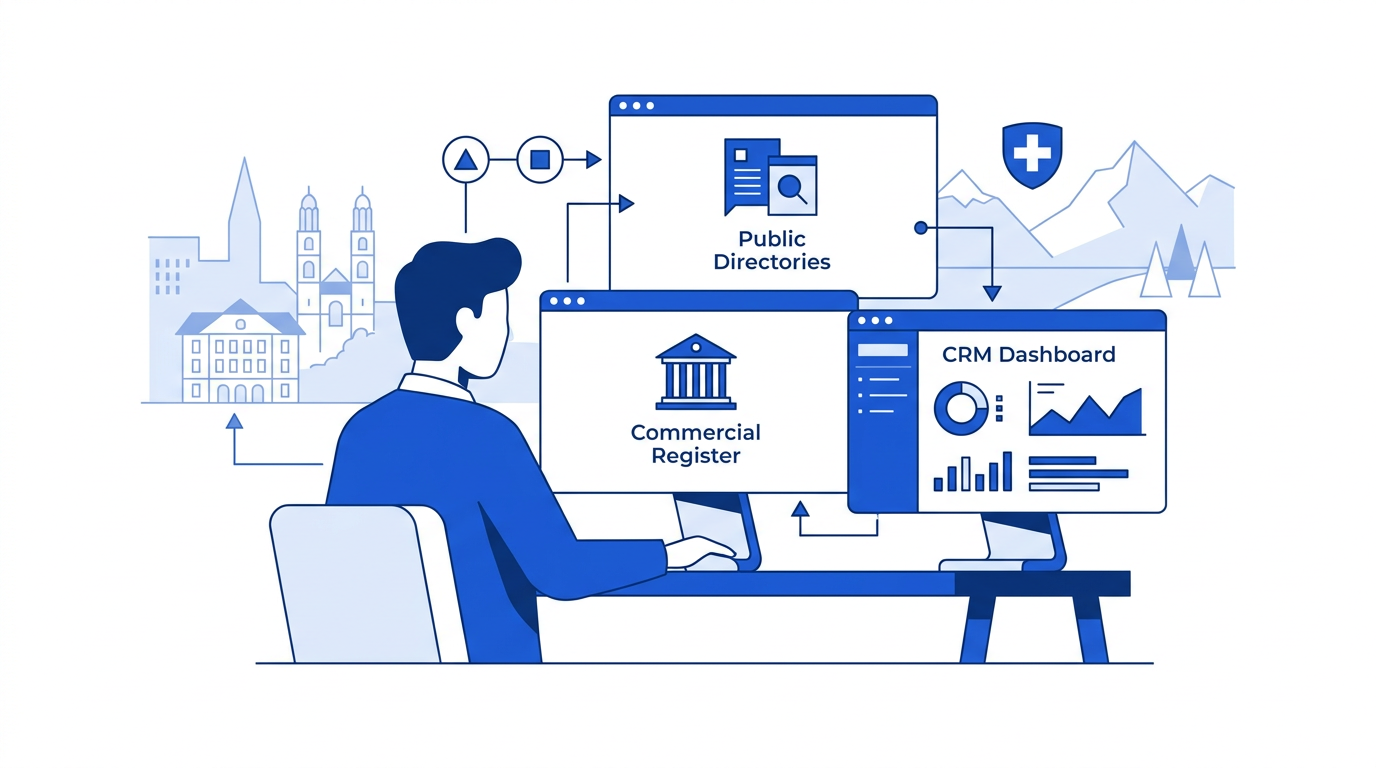
A B2B lead is ready for outreach only when you can answer four questions: Does the company exist, is it active, does it match your ideal customer profile, and is there a traceable business contact channel? If one answer is missing, the record still needs work.
Verification does not make data permanently accurate. An email account can close after it is checked, a branch can move, and a directory listing can lag behind reality. A better target is a repeatable process with identifiable sources, a verification date and clear status labels. Your sales team can then separate usable records from those requiring manual review.
What a verified business contact actually means
Verified does not mean sales-ready or interested. Verification concerns the reliability of the record. Qualification concerns whether the company represents a plausible commercial opportunity.
A sound record should include at least the legal or trading name, location, business category, source, review date and one contact channel. For registered entities, the Swiss UID number is a useful identifier. A missing email does not automatically make a lead worthless. For some tradespeople, practices and small local businesses, the telephone number or website form is the better-maintained route.
Three CRM statuses are more useful than a single checkbox:
- verified: identity and active operations are supported by consistent sources;
- partially verified: the business appears legitimate, but a contact is missing or details conflict;
- exclude: inactive, duplicated, outside the target profile or insufficiently supported.
This distinction prevents uncertain records from entering a sequence merely because an email address is present.
A workflow for verifying Swiss B2B leads
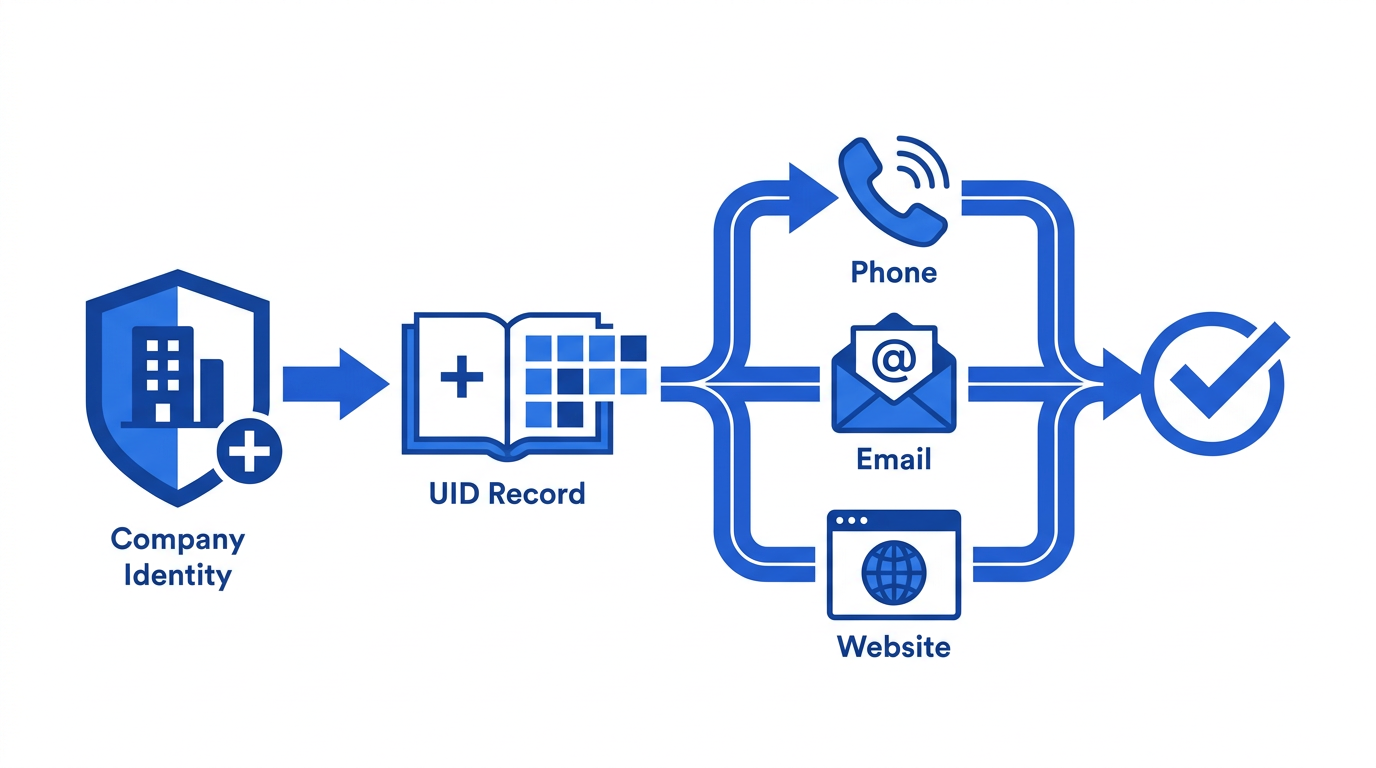
1. Confirm the company’s identity
Start with the name, but do not rely on it alone. Similar names may occur in different cantons. Compare municipality, postcode, street address, website and telephone number across local.ch, search.ch or Google Maps. Slightly different listings may belong to one company, while the same short trading name can identify separate legal entities.
Consider a construction supplier in Zug. Its website may promote a brand while the commercial register shows another legal name. Keep both in separate fields. The trading name helps personalise outreach; the legal name supports unambiguous identification.
2. Check Zefix and the UID number
Zefix, Switzerland’s central business name index, can confirm a registered entity’s status, seat and legal form. Record the UID when available. A current register entry generally carries more weight than an abandoned Maps profile. A missing Zefix result does not, by itself, prove that no business exists, as small economic activities do not all appear in the register in the same way.
For campaigns aimed at incorporated businesses, the UID is also a strong deduplication key. Our guide to the Swiss commercial register explains how this source fits into company research.
3. Confirm the fit with your target profile
An active company can still be a poor lead. Review the company website, stated services and actual operating area. Do not infer employee count, revenue, budget or decision-making authority from a broad directory category.
An international software vendor targeting dental practices in Lausanne should distinguish an independent practice, a multi-dentist clinic and a dental laboratory. They may appear in neighbouring search results, but their needs and buying processes differ. Add a short inclusion reason such as “Lausanne dental practice offering online booking” rather than retaining only “dentist”.
4. Validate the phone, domain and email
Open the website and confirm that its name, address and services match the record. For email, give greater weight to an address published on the company’s own site. Generic addresses such as info@ can be entirely appropriate for Swiss SMEs, but they should not be labelled as direct contacts for an owner or executive.
Technical syntax and domain checks can remove obvious errors. They cannot prove that somebody reads the mailbox, that the person has decision authority or that outreach is appropriate. If an email appears only in an old third-party listing, mark the lead as partially verified.
5. Store the source and verification date
A verified label without a date becomes misleading. Save the source URL or name and the day it was reviewed. Set refresh intervals according to likely change. Local venues and small operators may need more frequent checks than organisations with stable premises and structure.
Cleaning the database and improving CRM data quality
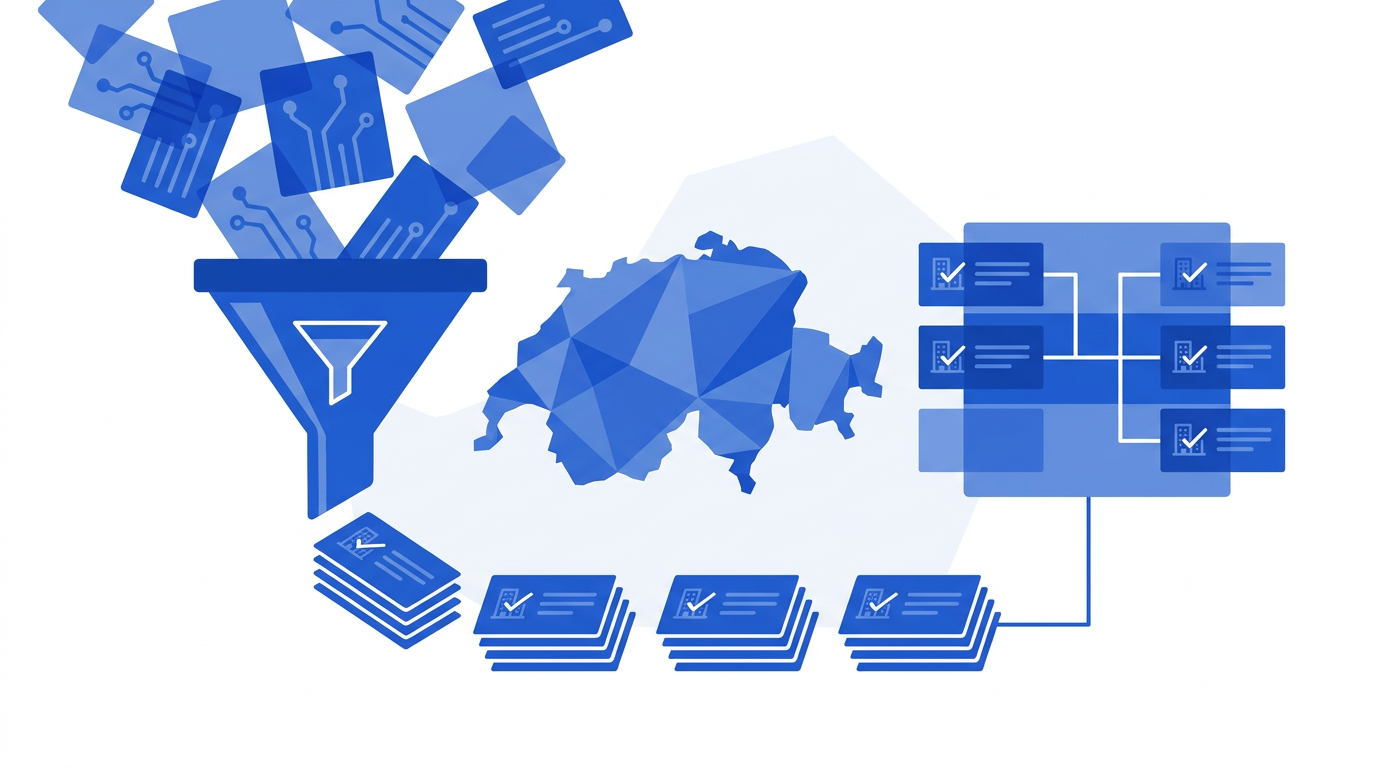
Database cleaning should start before import. Define required fields and standard formats for legal name, trading name, postcode, municipality, canton, domain, phone, email, UID, source, verification date and status.
Look for duplicates using UID and domain first. Then compare combinations of normalised telephone number, address and company name. Do not automatically merge branches merely because they share a domain. Separate locations may have different numbers, responsibilities and commercial potential.
Standardise Swiss telephone numbers, for example in the international +41 format. Store postcode separately from municipality and use canton abbreviations consistently. Information needed for segmentation should not live only in free-text notes, where it is difficult to filter and maintain.
Instead of deleting every rejected record, retain an exclusion reason where appropriate: inactive, duplicate, irrelevant, invalid contact or do not contact. This prevents the same business from being collected and imported again during the next list-building exercise.
When cleaning an existing customer database, protect relationship history. A duplicate may contain past calls, opt-outs or contract notes that the newer record lacks. Merge only after deciding which fields and activity logs must survive.
Legal checks before outreach in Switzerland
Publicly available does not mean unrestricted. Switzerland’s revised Federal Act on Data Protection, commonly referred to as the revDSG or nLPD, requires transparent, proportionate and secure processing of personal data. A generic company inbox raises different considerations from a named individual’s direct email address.
The Swiss Unfair Competition Act, UWG, is also relevant to commercial communications. Avoid large automated campaigns without assessing relevance, sender identification, objection mechanisms and the context in which the details were published. For telephone outreach, pay particular attention to the asterisk in Swiss directory listings. It indicates that the subscriber does not want advertising calls. Maintain an internal suppression list as well.
These are operational principles, not legal advice. High-volume processing, named-person profiling or sensitive segmentation should be reviewed by a qualified Swiss adviser.
International teams should also avoid assuming that a process accepted elsewhere is automatically suitable in Switzerland. Keep evidence of where a contact came from, limit unnecessary personal fields and make opt-outs easy to apply across every sales tool, not just the email platform.
The final check before pressing send
Review a random sample rather than only the top rows. Confirm that each business is active, located in the intended area and genuinely provides the relevant service. Check that the domain belongs to the company and that the email and telephone number have a recorded source. Then review duplicates, suppression flags and ageing verification dates. Your message should also have a specific reason to reach that recipient.
Swiss Lead Pro gathers company data from public sources including local.ch, search.ch, Google Maps and Zefix, extracts available email addresses and supports CSV export. It reduces manual collection work, but it cannot determine whether a company needs your offer or guarantee that every contact remains valid. Final qualification remains your responsibility. See how the app works and review the available plans.
Start with a small list, inspect a sample manually and import only records that satisfy your rules. You can use Swiss Lead Pro’s Free plan, which includes three searches per month, to test the workflow before scaling it.
Try Swiss Lead Pro
Build Swiss company lists with phone, email and Zefix data. 3 free searches.
Start free