Effective Cold Emails in Switzerland: The Structure That Gets Responses
18 November 2026
Discover how to structure cold emails that not only get opened but generate concrete responses in the Swiss market, respecting local regulations and culture.
In Switzerland, cold emails are still a powerful tool for B2B lead generation, provided they are well-structured and respect the market's specificities. Forget mass mailing and generic messages: here, precision, relevance, and legal compliance make all the difference. Let's explore together how to build a cold email that doesn't end up in the trash but opens a dialogue.
The Swiss Approach: Quality Over Quantity
The Swiss market is known for its culture of quality, discretion, and adherence to rules. This also translates into how Swiss companies and professionals perceive unsolicited commercial communications. An effective cold email is not just well-written; it's tailored to the recipient, targeted at their specific needs, and sent with utmost professionalism. This means conducting thorough research on your potential clients before hitting send.
Step 1: Preliminary Research – Know Your Contact
Before you even think about the subject line, you need to know who you're writing to. This doesn't just mean the company name, but also the person's role, the challenges they face, and how your service or product can tangibly help them. Sources like local.ch, search.ch, Google Maps, and the Zefix commercial register are excellent starting points for finding companies and their public data. Our tool, Swiss Lead Pro, helps you in this exact phase, providing you with lists of verified B2B leads with extracted emails, facilitating your research.
What to look for:
- Industry and company size: A medium-sized construction company in Zug will have different needs than a marketing agency in Geneva.
- Recent news: Have they just launched a new product? Have they expanded? This can give you a hook for personalization.
- Contact's role: Are you writing to the CEO, sales manager, or CTO? Each role has different priorities.
Step 2: The Email Subject Line – Your First and Only Impression
The subject line is the gateway to your email. In Switzerland, clarity and relevance far outweigh clickbait. Avoid generic phrases like “Business Proposal” or “Opportunity.” Be specific, concise, and, if possible, personalized. The goal is to communicate value immediately.
Examples of effective subject lines:
Inquiry: Logistics Optimization for [Company Name]Web Development for [Company Name]: An Idea for Your Online Presence[Your Name] from [Your Company]: An Approach to [Contact Name/Company Name](if there's even a weak connection)Improving Project Management at [Company Name]
Step 3: The Email Body – Value, Clarity, and Conciseness
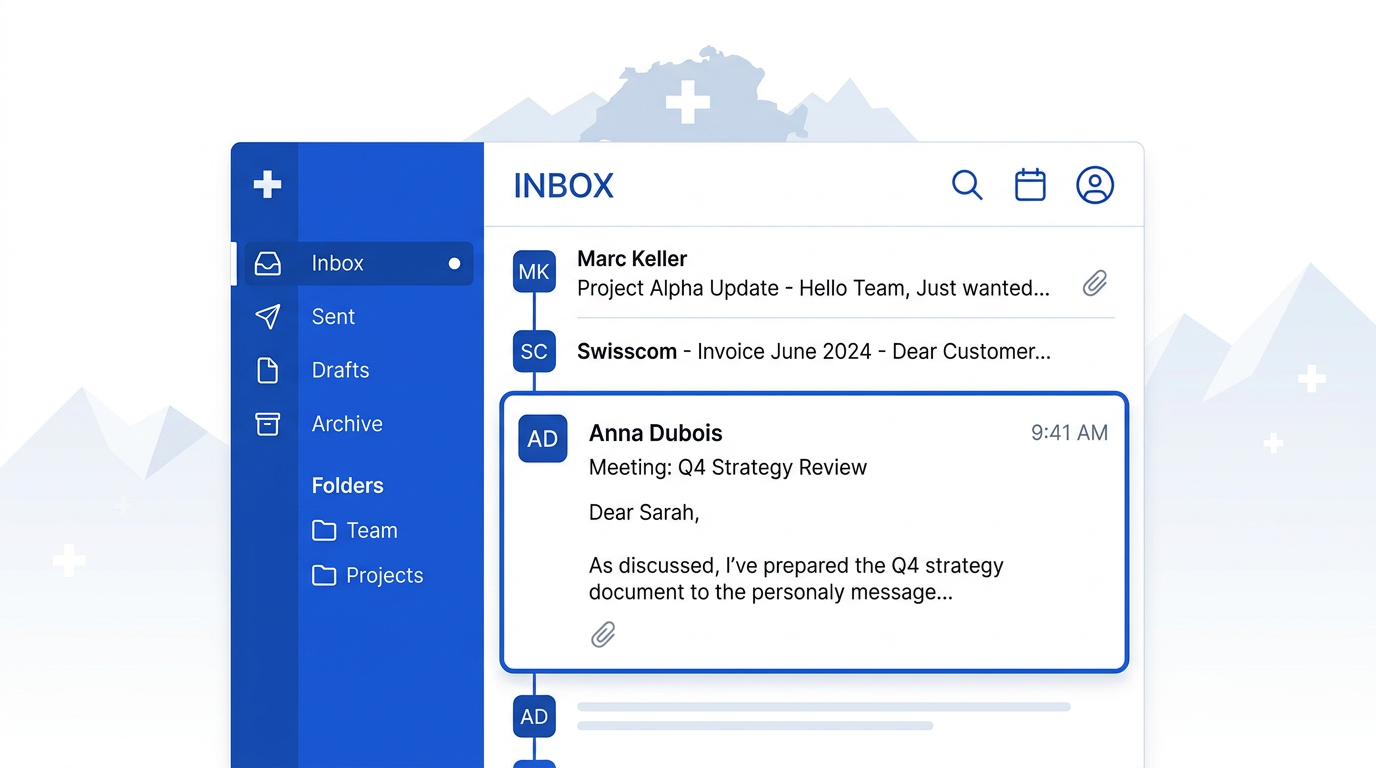
Once the message is opened, you have a few seconds to capture attention. The structure should be logical, easy to read, and straight to the point. Remember, your goal is not to sell immediately, but to get a response or a meeting.
Key elements of the email body:
- Personalized Greeting: Always use the contact's name. "Dear Ms. Rossi" or "Dear Mr. Meier" is the standard approach in Switzerland.
- Opening Hook: Connect your message to something specific you've noticed about the company or industry. "I noticed your recent expansion project and was wondering..." or "I see that [Company Name] is facing the challenge of...". A reference to an industry fair or an article they've published can work very well.
- The Problem and Your Solution (briefly): Describe a common problem your contact might have and how your solution addresses it. Don't describe your features, but the benefits. Instead of "We offer a CRM with X features," say "We help companies like yours reduce customer management time by 20%, allowing you to focus on growth."
- Social Proof (optional and brief): If relevant, briefly mention a result achieved with a similar client, without violating confidentiality. "We helped a similar company in [city/industry] achieve [result]."
- Clear and Low-Commitment Call to Action (CTA): Don't immediately ask for an hour-long meeting. Ask for something smaller, like an answer to a question or the possibility of sending additional material. "Would you be interested in learning more about how we could help you achieve [specific goal]?", "Could I send you a relevant case study?", "Do you have 15 minutes next week for a brief chat?"
- Professional Signature: First name, last name, role, company, website, and phone number. Avoid excessive graphics or lengthy disclaimers.
Step 4: Legal Compliance and Privacy (nLPD/revDSG and UWG)
In Switzerland, data protection is a serious matter. The revision of the Federal Act on Data Protection (nLPD/revDSG) and the Unfair Competition Act (UWG) establish clear rules for commercial communications. It's not as strict as GDPR's opt-in, but cold emails must respect important principles:
- Relevance: The email must be relevant to the recipient's activity. Do not send IT service offers to a dentist unless there is a clear connection.
- Identifiability: The sender must be clearly identifiable.
- Opt-out: You must always provide an easy way for the recipient to unsubscribe or request not to be contacted again. "If this communication is not of interest to you, please accept our apologies for the intrusion and let us know if you prefer not to be contacted again."
- Asterisk in Directories: For private individuals, it is mandatory to respect the asterisk in telephone directories. For B2B, the interpretation is more flexible, but good practice suggests caution and respect for the recipient's wishes.
Step 5: Follow-up – Intelligent Persistence
Don't expect an immediate response to every email. Follow-up is crucial, but it must be strategic. Wait a few days (3-5 business days) and send a brief reminder email, adding a small value or a new insight, without being pushy.
Follow-up example:
Subject: RE: [Previous Subject] - A Small Additional Thought
Dear Ms. Rossi,
I am writing to you regarding my email from [date], concerning [topic].
Thinking about our industry, an interesting fact/short article on [relevant topic] came to mind that you might find useful.
If you have a moment to take a look, I would appreciate your thoughts. Otherwise, no problem, and thank you for your time.
Sincerely,
[Your Signature]
Extra Tips for the Swiss Context
- Language: If you're unsure of the preferred language, Swiss German (for German-speaking Switzerland), Swiss French (for Romandie), or Italian (for Ticino) are preferred. English is acceptable in many international contexts, especially in specific sectors like finance or technology, but personalization in the local language shows attention and respect.
- Tone: Maintain a professional, respectful, and slightly formal tone. Avoid excessive familiarity.
- Don't take anything for granted: Clearly explain who you are and why you are contacting them.
Transform Your Cold Email Strategy with Swiss Lead Pro
Building relevant and verified B2B lead lists is the crucial first step for successful cold emails. Swiss Lead Pro offers you access to a database of Swiss companies, allowing you to extract email addresses and valuable data in a few clicks. Start with our Free plan (3 searches/month) or discover our Pro and Unlimited plans to take your lead generation to a new level. Discover our pricing and start generating qualified leads today.
Try Swiss Lead Pro
Build Swiss company lists with phone, email and Zefix data. 3 free searches.
Start free